What Does Crowning A Tree Mean? – Questions
If you work with expert arborists, validate that they are certified, bonded and insured. Some arborists may also be certified by an expert association, the International Society of Arborists (ISA). ISA licensed arborists have actually passed exams to show their knowledge of correct tree care practices and generally go to upgrade training yearly.
Do not be scared to ask the arborist questions or request recommendations from their previous regional pruning jobs. Arborists certified by the ISA are found in New Mexico communities. Contact details may be located in your telephone directory. To prune branches of various sizes you may require(fig. 3): Figure 3. Pruning tools Hand shears (a): reliable for small branches and branches Lopper shears (b): offer more leverage for branches 1 1/2 inches or less in diameter A pruning saw (c): cuts big, woody limbs 6 inches or less in diameter A chainsaw (d): makes fast work of limbs greater than 3 inches in diameter but should not be used on small limbs since of its shredding effect Pole-pruners (e): consist of a saw and a lopping shear on an extendable shaft for cutting branches numerous feet off the ground Security safety glasses and construction hat: (specifically when pruning branches overhead) The cut is the crucial to good pruning.
This method encourages managed, healthy new growth. If you're not sure whether to eliminate a branch, don't cut. You can always cut it later, but you can never ever put it back. At the position where each branch stems from the trunk is a "collar" in between the branch and the trunk (fig.
The Main Principles Of Do Trees Need To Be Pruned?
AAA – Tree Lopping Ipswich
79 Cameron St, Redbank Plains QLD 4301This branch collar contains vascular tissues from both the branch and the trunk. If you cut into the trunk tissue, you will disrupt the tree's natural protective systems, allowing the entry of disease and pest pests which damage the tree trunk. Make your pruning cut outside the collar on the branch side without leaving a stub.
Branch collar and appropriate area for pruning cut Many pruning shears have just one cutting blade. Orient your shears so that the blunt jaw presses on the portion of the limb that will be disposed of. Incorrect orientation may damage the tissue of the branch collar, slowing the wound-closing process. Removing big limbs requires 3 cuts (fig.
Make the first cut (1) into the underside of the limb about 6 inches beyond the bark collar, cutting 1/4 to 1/3 up through the limb. Make the second cut (2) from the top down a number of inches farther out than the very first cut, cutting till the branch breaks away (2a).
Some Known Factual Statements About How Do You Fix A Topped Tree?
Figure 5. Cutting big limbs V-shaped crotches threaten tree health and pose a public security danger, as bark typically ends up being trapped between limbs, leading to weak attachment. To get rid of narrow crotches prior to they end up being severe issues, remove the least desirable limb (fig. 6). If no branch collar is apparent, begin at (1) and cut upward at a 30 ° angle, completing the cut at the branch's point of origin (2 ).
Removing V-shaped crotches Topping is the indiscriminate shortening of limbs that triggers a cluster of unruly, weakly attached branches to emerge near the cut (fig. 7). These branches are subject to damage from wind, http://query.nytimes.com/search/sitesearch/?action=click&contentCollection®ion=TopBar&WT.nav=searchWidget&module=SearchSubmit&pgtype=Homepage#/tree crop loads, bugs, illness and damage under their own weight. Topped trees have actually shortened life expectancy, pose security hazards to individuals and property and require continuing extensive maintenance.
Figure 7. Never ever top a tree Pollarding looks like topping, but there are differences in the procedure that relate to the way in which trees grow. In pollarding a tree, a branch is cut down when it disappears than 2 years of ages. The tree is capable of safeguarding itself from entry of illness and pests at this stage of development however not later. Tree pruning: an around the world photo guide. Durham, NH: Shigo & Trees, Associates Pruning Trees and Shrubs Mike Zins and Deborah Brown, Extension Horticulturists.
The Buzz on How Do You Reduce The Height Of A Tree?
Trees require pruning for a variety of factors: to remove unhealthy or damaged branches to thin the crown to permit new development and better air blood circulation to reduce the height of a tree to get rid of obstructing lower branches to shape a tree for style purposes Once the decision has actually been made to prune, your next decision is whether or not to deal with the job yourself.
When it comes to a big tree where you wish to remove huge branches in the upper location of the crown, it might be best to hire professionals. When pruning, it is important to prune the undesirable branch while safeguarding the stem or trunk wood of the tree. Tree branches grow from stems at nodes and pruning always happens on the branch side of a stem-branch node.
All pruning cuts need to be made on the branch side of this stem collar. This protects the stem and the other branches that might be growing from it. It likewise enables the tree to heal more successfully after the prune. To avoid tearing of the bark and stem wood, especially in the case of bigger branches, utilize the following treatment: Make a little wedge shaped cut on the underside of the branch simply on the branch side of the stem collar.
The Greatest Guide To How Do I Prune A Large Tree?
Rather further along the branch, beginning at the top of the branch, cut all the method through the branch leaving a stub end. Lastly, make a third cut parallel to and simply on the branch side of the of the stem collar to lower the length of the stub as much as possible.
This is called a drop crotch cut. Make the very first notch cut on the underside of the branch you're pruning well up from the crotch. For the 2nd cut, cut entirely through the branch from inside the crotch well up from the ridge of bark signing up with the two branches.
Dead branches can and need to be gotten rid of at any time. A tree's inactive season, late fall or winter season, is the very best time to prune. Pruning during the inactive period decreases sap loss and subsequent tension to the tree. It also lessens the danger of fungi infection or insect problem, since both fungis and bugs are likely to be dormant at the exact same time as the tree.
The Best Guide To How Do You Reduce The Height Of A Tree?
When choosing just how much to prune a tree, as low as possible is often the very best guideline. All prunes put stress on a tree and increase its vulnerability to disease and bugs. Never prune more than 25% of the crown and make sure that living branches compose a minimum of 2/3 of the height of the tree.
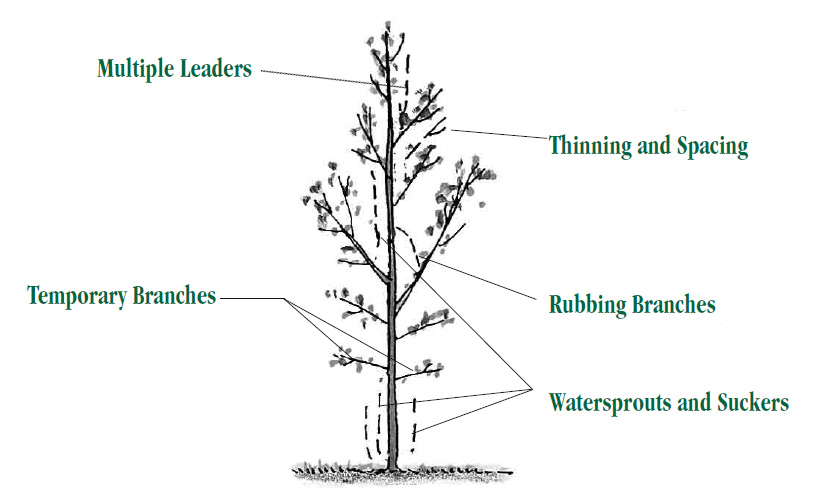
In many cases, storm damage, height reduction to prevent crowding utility lines or perhaps raising the crown to satisfy community laws, your pruning options are made for you. But even in these instances, prune just you can get away with. Prune the tree for the following: Prune basal suckers (sprouts that grow out at the base of a tree).
Prune any codominant leaders or narrow crotch angles. Prune rubbing or crossed branches. Prune any broken branches. Trees naturally close injuries that result from branch elimination, so pruning wounds ought to be delegated close without any help. Likewise, because the majority of pruning must be done in late fall or winter, pests must not be much of a problem.

Little Known Questions About Can You Put Too Much Mulch Around A Tree?.
In specific, you should seal pruning injuries on trees that are vulnerable to damaging insect invasion such as birch, oak, and elm trees. Also, if the weather is particularly dry, a pruning sealant will assist the tree retain more wetness.
A tree may require pruning for a range of reasons: · to get rid of unhealthy or storm-damaged branches · to thin the crown to allow brand-new development and better air blood circulation · to reduce the height of a tree · to eliminate blocking lower branches · to form a tree for design functions Once the choice has actually been made to prune, your next choice is whether or not to take on the task yourself.
 Tree Lopping Brisbane News 9881